

Blogi
%20(1).png)

Google Ads is the first step into digital advertising for many companies. And for good reason – it offers the opportunity to reach potential customers exactly when they are looking for a solution to their needs. When someone searches on Google for a service or product, your company can be among the first search results.
Yet, many companies have a mixed experience with Google Ads. Ads get clicks, but few inquiries are generated. Money is spent on advertising, but its impact on the business is difficult to assess.
Often, the problem is not with Google Ads itself. The challenge lies in viewing advertising as an isolated activity, even though the customer's buying journey begins before the search and continues long after the first click.
When Google Ads is built as part of a company's overall marketing strategy, it is not just a way to buy visibility. It is a tool to reach the right people at the right time and guide them toward making contact, requesting a quote, or completing a purchase.
What is Google Ads?
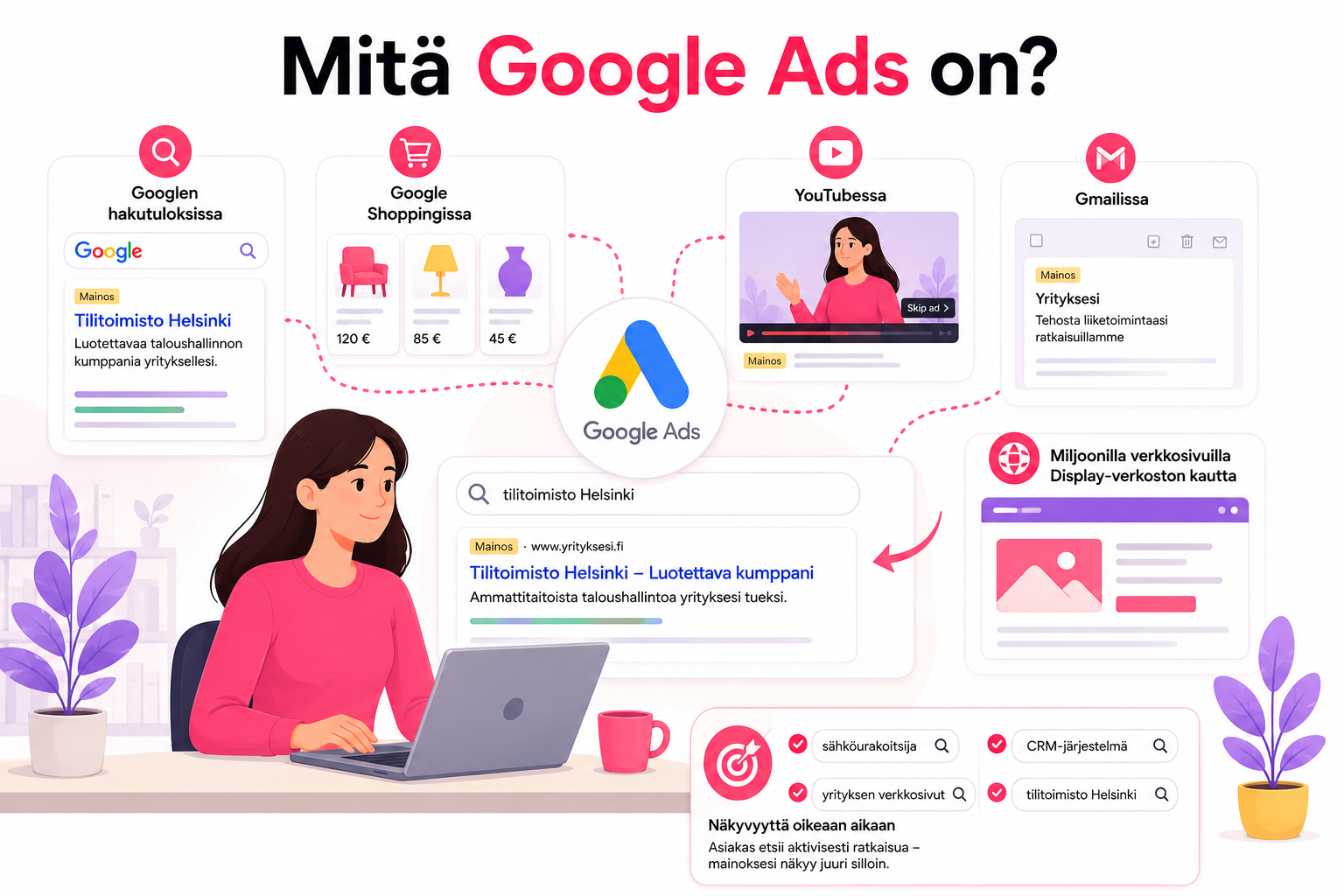
Google Ads is Google's advertising platform that allows companies to appear in places such as:
For Finnish SMEs, the most important form of advertising is usually search engine marketing. In this format, the company appears when a customer is actively searching for the service or solution they offer.
For example:
- electrical contractor
- company website
- CRM system
- accounting firm Helsinki
Searches like these often indicate purchase intent. This is why Google Ads differs from, for example, social media advertising: the user isn't being interrupted to see an ad, but is already actively looking for a solution.
Why are so many companies interested in Google Ads?
Google Ads offers one significant advantage.
You don't have to wait months for visibility.
Search engine optimization builds organic visibility gradually. Google Ads, on the other hand, enables visibility the moment a campaign is launched.
This makes it a great option when, for example:
- a company is launching a new service
- you want to increase quote requests quickly
- a new office is opening
- you are testing new target audiences
- the season is about to begin.
However, quick visibility doesn't automatically mean good results. Advertising can bring in a lot of visitors, but if the rest of the customer journey doesn't support decision-making, clicks won't turn into customers.
Google Ads in 2026 – AI does more, but not everything
Google Ads has changed significantly in recent years.
Previously, campaigns were largely managed manually. Bids were adjusted keyword by keyword, ad groups were built precisely, and optimization was highly technical.
Today, much of this happens automatically.
Google utilizes AI for things like:
- bidding strategies
- targeting
- in combining ads
- in Performance Max campaigns
- in making forecasts.
However, this does not mean that the company's role has diminished. Quite the opposite.
As AI takes care of an increasing share of technical optimization, the things it cannot solve on behalf of the company become even more important:
- business goals
- understanding the target audience
- standing out from competitors
- website persuasiveness
- high-quality content.
AI can optimize a campaign, but it doesn't know why a customer should choose your company specifically.
Search intent matters more than keywords
Many people think of Google Ads in terms of keywords. In reality, it is more important to understand what the customer is trying to achieve. Consider two searches: "CRM system" and "how to manage customer data more effectively." The first user is likely looking for software. The second is looking for a solution to their problem.
If a company understands this difference, it can build ads and landing pages that better address the customer's actual need. Google Ads is therefore not just about buying keywords. It is about understanding how the customer thinks.
What happens after the click?
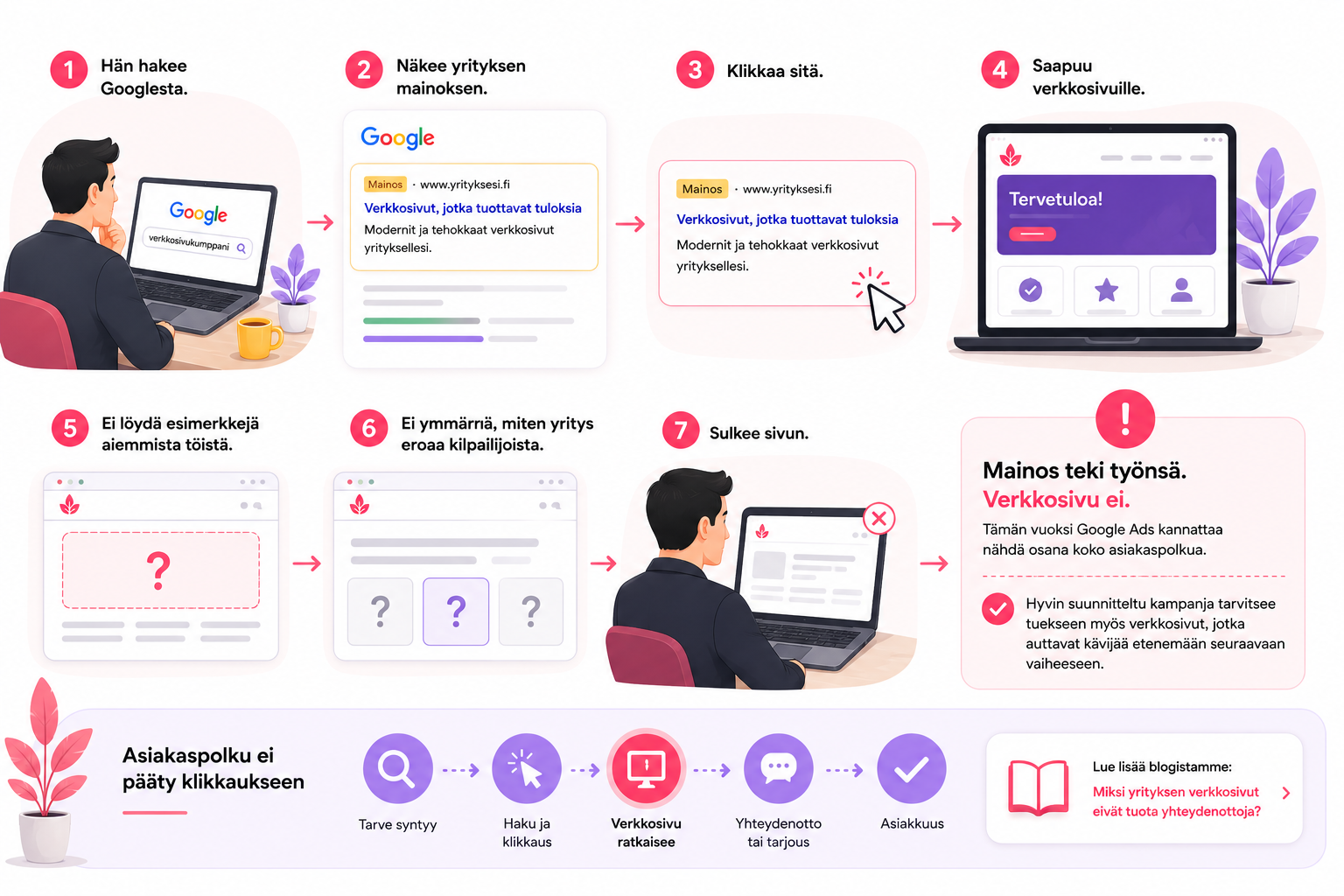
Many campaigns fail only after the user has already clicked the ad.
A well-planned campaign also needs the support of a website that helps the visitor move to the next stage. We cover this topic in more detail on our blog Why isn't your company website generating leads?
What should you do before your first Google Ads campaign?
Building the campaign technically is often the easiest part. The harder question is: What does the company actually want to achieve?
Before launching your first campaign, you should at least ensure the following:
Goals
Is your goal:
- generating leads
- requesting quotes
- online store sales
- booking appointments
- increasing brand awareness?
Target audience
Who are your company's best customers?
Not all visibility is valuable if it reaches the wrong audience.
Landing pages
Does the page answer the question that prompted the user to click the ad?
Conversion tracking
If leads aren't measured, it's impossible to evaluate the success of a campaign.
Analytics
What happens after a user arrives at your website?
How much does Google Ads cost?
This is one of the most common questions. However, there is no single right answer. In Google Ads, you don't buy ads at a fixed price. A company usually pays when a user clicks on an ad. The cost per click varies greatly depending on the industry.
But a more important question is:
How much does it cost to acquire a new customer?
If a campaign generates high-quality leads profitably, the cost per individual click matters significantly less than the overall performance.
The most common reasons why Google Ads fails to deliver results
Companies that have tried Google Ads sometimes say the service didn't work for them.
In most cases, however, the reason lies in one of the following.
Target audiences that are too broad
Ads are being shown to people who aren't in the market to buy.
The landing page doesn't match the search intent
The ad promises a solution, but the website talks about something else.
The goal is unclear
If the purpose of a campaign hasn't been defined, success cannot be measured either.
Evaluating advertising too quickly
Google needs data to learn.
Often, the first few weeks are just the starting point for optimization.
Relying solely on automation
Automation makes things easier, but it doesn't replace strategy.
Google Ads or SEO?
Companies often ask which one they should invest in. In reality, these are not competitors. Google Ads provides immediate visibility. Search engine optimization builds visibility over the long term. When a company combines the two, it gains both quick results and sustainable growth.
Google Ads can also help identify the search terms customers use to find services. These insights can be leveraged in blogs, service pages, and other content creation. On the other hand, high-quality search engine visibility can reduce reliance on paid advertising over time.
It’s not about an either-or mindset, but rather about how different methods support each other.
Google Ads is part of a broader marketing strategy
Google Ads rarely works in isolation. Consider a company aiming to increase inquiries. Google Ads brings in the visitors. Your website creates the first impression. Your content answers the customer's questions. Your brand builds trust. Search engine optimization increases organic visibility. Analytics show you what is working.
When these elements support one another, a single advertising campaign can generate significantly more value than if each marketing component operated as a separate, disconnected project. This is precisely why Google Ads should be viewed as part of a marketing ecosystem rather than just a way to buy more clicks.
Summary
Google Ads is a powerful tool for companies that want to reach customers exactly when they are actively searching for a solution to their needs. However, its true value does not come from visibility alone.
Advertising delivers the best results when it is integrated into a broader framework: a clear strategy, functional websites, high-quality content, and ongoing analytics. Clicks are only the beginning of the customer journey. From a business perspective, what happens after the click is what truly matters.
Frequently asked questions
Is Google Ads worth it for a small business?
Yes, provided your goals are clear and your campaigns are targeted correctly. Even a smaller budget can yield good results if the advertising reaches the right audience and your website effectively encourages inquiries or purchases.
How quickly does Google Ads start working?
Ads can appear as soon as a campaign is launched. However, a reliable assessment of campaign performance generally requires several weeks of monitoring and continuous optimization.
Does Google Ads replace search engine optimization?
No. Google Ads provides immediate visibility, while search engine optimization builds organic presence over the long term. At their best, they support each other.
Is getting a high volume of clicks the most important thing in Google Ads?
No. Clicks are just one metric. From a business perspective, it is more important to track how many visitors convert into inquiries, quote requests, or customers.
If this topic sparked some thoughts
Google Ads can be an effective way to reach new customers, but the best results are rarely the product of a single campaign. If you would like to discuss how search advertising could support your company's specific goals as part of a broader marketing strategy, we would be happy to talk.