




Blogi


Marketing rarely fails because a company lacks ideas.
More often, the problem is the opposite.
Ideas keep coming, but there is no clear structure to connect them. One month you're posting on social media, the next you're launching an ad campaign, and then you realize the website content needs updating. Eventually, marketing starts to feel like a series of isolated tasks done based on whatever happens to be urgent at the moment.
This is where a marketing annual plan.
A marketing annual plan doesn't mean you have to decide on every post or campaign a year in advance. Its purpose is to help you see your marketing as a whole: what you are doing, when you are doing it, and, above all, why you are doing it.
A well-structured annual plan gives your company direction while still leaving room to react to changes in the environment.
What is a marketing annual plan?
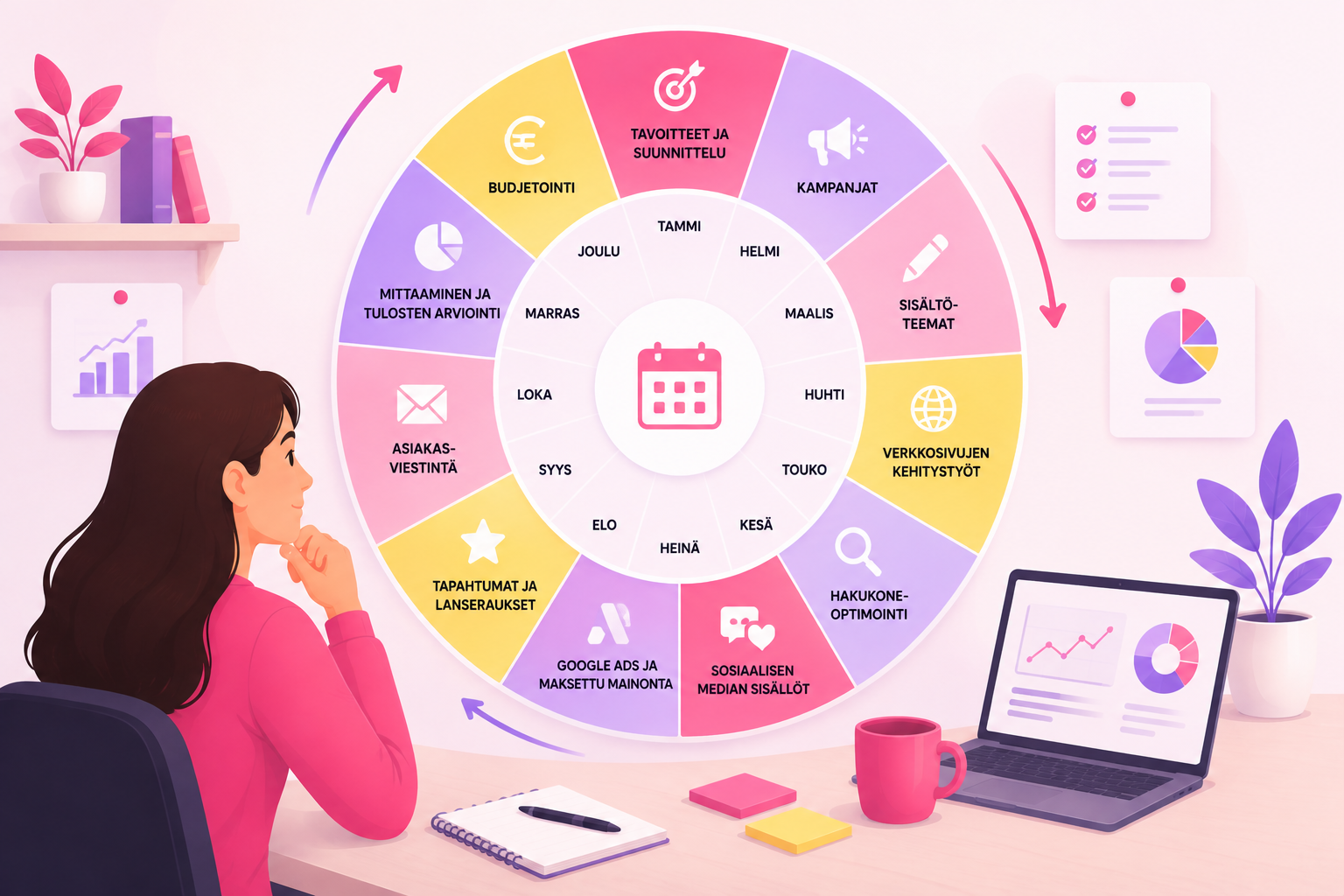
A marketing annual plan is a planning tool used to map out a company's key marketing goals, timelines, and activities on a calendar.
You can use it to mark, for example:
- key business milestones
- seasonal trends and sales periods
- campaigns
- content themes
- website development projects
- search engine optimization
- social media content
- Google Ads and other paid advertising
- events and launches
- customer communication
- marketing budgeting
- measurement and performance evaluation.
However, an annual plan doesn't have to be a massive spreadsheet that lists every single marketing task.
Above all, a good annual plan shows the rhythm of your marketing.
When are your customers most active? When does sales need more demand? When should you build visibility for the upcoming season? And when is it more sensible to analyze results rather than publish more content?
An annual plan helps you answer these questions.
Why should you create a marketing annual plan?
The greatest benefit of a marketing annual plan isn't the calendar itself.
It’s the mindset.
When marketing is planned in advance, the company is forced to pause and consider what it actually wants to achieve. This helps distinguish between just being busy and doing goal-oriented marketing.
Without a plan, marketing can look something like this:
"We should post something on social media."
With an annual plan, the question changes to:
"What do we want our customers to understand at this stage of the buying journey, and what content will help us achieve that?"
The difference is significant.
Marketing is no longer just about generating visibility, but becomes a part of achieving business goals.
An annual plan also helps with resource planning
Especially in SMEs, marketing is often carried out with limited resources.
You cannot do everything at once.
When the most important times of the year are visible, resources can be allocated more effectively. If you know that there is an important sales period in the autumn, you don't have to start building the related content, web pages, and advertising in a rush during the first week of September.
The work can be started earlier.
This is one of the most important functions of an annual marketing calendar: it shifts marketing from reactive tasks to proactive planning.
An annual calendar also helps with budgeting
When the most important marketing activities for the year are visible, budgeting becomes easier as well.
It is not necessarily wise to think of the marketing budget as the same amount spent every month. If your company's demand or sales are concentrated at certain times, marketing resources can be allocated around those periods.
An annual calendar helps you see in advance, for example:
- when more paid visibility is needed
- when new content is produced
- when websites are developed
- when campaign materials are needed
- when fewer resources can be used for marketing.
This way, budgeting is based on what you actually want to achieve during the year, rather than just copying the previous year's budget.
The marketing annual calendar starts with the business
One common mistake is to start the annual calendar with marketing channels.
First, you decide that you will post on LinkedIn in January, run a campaign in February, and produce a video in March.
A better starting point is the business itself.
Ask first:
- What are the company's main goals for this year?
- When is it important for sales to generate more demand?
- Are there any seasonal peaks or other significant times during the year?
- Which new products or services are you looking to grow?
- Which customer purchasing decisions do you want to simplify?
- What should the company become better known for?
Once these things are clear, we can consider what kind of marketing will support them.
This prevents the annual plan from becoming just a content calendar.
How to build a marketing annual plan
You don't have to start building a marketing annual plan from a blank calendar. A clear roadmap helps keep the big picture manageable.
1. Define business goals
Start with what the company needs to achieve.
Is the goal to increase sales, strengthen brand awareness, launch a new service, generate more leads, or, for example, build long-term search engine visibility?
The purpose of marketing is not to invent things to do. It should support the company's direction.
2. Identify customers and their buying journeys
Not all customers are at the same stage.
Some do not yet recognize the problem your company could solve. Some are actively looking for alternatives. Some are already comparing suppliers and are close to a purchasing decision.
It is worth considering these different stages in your annual plan.
If marketing speaks all year only to people who are already ready to buy, the company may remain invisible to those who are just forming an understanding of their needs.
On the other hand, building awareness alone won't help if the customer isn't provided with enough information to support their purchasing decision.
That is why content, websites, and campaigns should serve the customer journey as a whole.
3. Identify key dates throughout the year
Mark your calendar with, for example:
- seasons
- sales periods
- launches
- events
- trade fairs
- holiday periods
- industry-specific milestones
- the company's own milestones.
Also, remember to look at what happens before the actual sales period.
If a customer's purchasing decision takes time, you shouldn't wait until the sales period is already underway to start your marketing.
4. Plan your marketing activities
Once your goals, customers, and key dates are clear, it's time to decide on the tactics.
These could include, for example:
- blog content
- SEO
- social media
- Google Ads
- email marketing
- website development
- guides and downloadable content
- case studies
- events
- campaigns.
However, it is important to consider how these relate to one another.
For example, if an advertising campaign directs traffic to a website, the page must address the same need that the ad sparked. Conversely, if a blog post discusses a customer's problem, it can lead them to a service page or other content that supports a purchasing decision.
The different parts of your marketing should form a path, not a collection of disconnected tasks.
5. Schedule and allocate resources
Only at this stage does it make sense to decide when things will be done.
You don't need to schedule everything down to the day. It is enough to have the year's key initiatives visible and the work for the coming months planned in sufficient detail.
At the same time, you can assess what the company can handle in-house and where external expertise is needed.
6. Monitor, learn, and update
An annual marketing calendar is not finished once it has been created.
It should evolve throughout the year.
If a piece of content performs better than expected, you might want to cover the topic further. If a campaign doesn't yield the desired results, you don't need to build the next one the same way just because it's marked in the calendar.
Planning your marketing doesn't mean being rigid. It means making changes consciously.
Make the most of quiet periods too
Not all months of the year are the same when it comes to marketing.
In some industries, summer can be quieter. In others, the end of the year might be slower. It pays for a company to identify these periods and consider how to make the most of them.
A quieter period can be a great time for things like:
- preparing upcoming content
- developing your website
- SEO work
- planning campaigns
- gathering customer insights
- reviewing analytics
- creating materials for the upcoming season.
This way, you don't have to rush your marketing efforts right when your most important sales season begins.
A quiet period doesn't necessarily mean you should stop marketing. It can mean shifting the focus from outward-facing activities to preparation and development.
What should you include in your marketing annual plan?
There is no single right structure. You should build your annual plan based on your company's specific needs.
However, for most companies, it is useful to look at at least these areas:
1. Key business dates
Start with the calendar.
Mark down things like seasons, sales periods, launches, events, and other dates that influence customer behavior.
2. Content themes
Think about what your company wants to talk about throughout the year.
If every month starts with the question "what should we post this week?", content planning can easily become a waste of time.
Instead, you can divide the year into a few major themes.
You can build multiple pieces of content for different channels from a single theme. This makes content production more consistent and also helps build search engine visibility.
3. Campaigns and advertising
If your company uses paid advertising, it should also be included in your annual plan.
This allows you to plan, for example:
- when to increase demand
- when to launch a campaign
- what content is needed before the campaign
- which page the ads should direct to
- what happens after the campaign.
An ad in itself is not a complete marketing strategy. If an ad sparks interest but the website doesn't answer the customer's question, some of the work goes to waste.
That is why it is worth considering your website and, if necessary, landing pages.
4. Website and other digital presence
The annual plan is also a great place for website development.
During the year, you can, for example:
- update service pages
- publish new expert content
- develop conversion paths
- check the functionality of key pages
- improve search engine visibility
- review analytics.
Your website is more than just a destination for traffic from other marketing channels. It is an integral part of your marketing strategy itself.
5. Measurement and development
It is also worth setting aside time in your annual plan to pause and reflect.
What happened last month?
Which content performed well?
Where did the traffic come from?
What did people do on the website?
Did the marketing efforts generate leads or other business-critical results?
Without this step, an annual plan can easily become just a list of tasks repeated the same way year after year.
The marketing annual plan as a company-wide tool
An annual plan is at its best when it is more than just a to-do list for the marketing team.
It can serve as a shared overview for the entire company of what is happening throughout the year.
Sales can see when new campaigns are launching. Management can understand how the marketing budget is being allocated. Content creators know which themes are coming up. Website development can be scheduled to align with major campaigns.
This reduces the risk of different people or partners working in silos without knowing what others are doing.
Especially when multiple people or partners are involved in marketing, a shared annual plan can be a simple way to keep the big picture visible.
It doesn't need to be a complex project management system. Even a simple, agreed-upon view of key goals, timelines, and activities can eliminate a lot of unnecessary friction.
It is worth integrating your marketing annual plan with your content marketing strategy
One of the best things about an annual content calendar is that it makes planning your content much easier.
When you know your key business goals for the year and the questions your customers are asking, you don't have to come up with content from scratch.
A single broader topic can generate, for example:
- a blog post
- a LinkedIn post
- a newsletter
- a short video
- a guide
- website content.
This way, the same idea can serve multiple channels.
You should also choose your social media channels based on where your customers are and what kind of content your company can realistically produce. We cover this perspective in more detail in the article Social media channels for businesses in 2026 – how to choose the right ones?.
This is also a matter of resources.
In a small business, the time available for marketing is usually limited. Therefore, being organized doesn't mean doing more. It can mean getting more out of the same resources.
An annual calendar connects the different parts of marketing
The true value of a marketing calendar lies in what happens between different activities. SEO generates visibility. Content helps the customer understand. Social media puts content in front of people. Advertising can increase reach when you want to boost demand. Websites help the customer move forward. Your brand influences the impression formed of your company during these interactions.
When these are planned together, marketing starts to look like a cohesive whole. If each part is planned separately, the risk is fragmented efforts: the ad says one thing, the website says another, and social media says a third.
In that case, a lot of time can be spent on marketing without the customer getting a clear overall picture of the company.
Also in corporate branding it is all about this continuity. A brand is not just visible in a logo or visual identity, but in how the company is perceived across its website, content, advertising, and customer interactions.
A marketing annual plan does not mean everything has to be decided in advance
This is an important thing to remember. An annual plan is not a prediction.
Customer needs change. A company's business can evolve. Some content may perform better than expected and spark a new topic that is worth exploring further.
That is why an annual plan should include two levels.
Long-term: what are we aiming for during the year?
Short-term: what are we doing right now and what have we learned?
This way, the plan provides direction for your work without preventing you from reacting to changes.
A good annual plan is more of a map than a schedule.
Example of a marketing annual plan
Let’s think about a company whose sales peak in the spring and autumn.
Its annual plan could look simplified like this:
This is just an example.
The point is not that every month must have its own campaign. The point is that different activities support each other and align with the company's goals.
What makes a good marketing annual plan?
A good annual plan is:
Clear. It needs to be easy to understand at a glance.
Flexible enough. Every week doesn't need to be fully planned out.
Business-driven. Marketing activities are based on what the company needs to achieve.
Customer-centric. Planning takes into account the customer's needs and buying journey.
Omnichannel. Different channels support the same overall goal.
Resourced. The plan also outlines where time and money are needed.
Measurable. Results are reviewed and the plan is adjusted as needed.
Practical. An annual calendar should make daily life easier, not more burdensome.
If an annual calendar requires more time to maintain than to actually plan the marketing, it is likely too complex.
A marketing calendar does not replace a strategy
The annual calendar tells you when things will be done.
Strategy explains why things are done.
The difference between these is important.
If a company doesn't have a clear understanding of who it wants to reach, what it wants to achieve, and how it wants to be perceived, an annual plan might look organized – but it won't necessarily move the company in the right direction.
That is why you should only build an annual plan once the foundation of your marketing is sufficiently clear.
Goals first. The customer second. Tactics only after that.
Summary: an annual plan makes marketing manageable
A marketing annual plan is more than just a calendar full of campaigns.
At its best, it helps a company see how marketing relates to business goals and how different activities support one another.
A good starting point is:
- 1. define the business goals for the year
- 2. identify your customers and their buying journeys
- 3. identify key seasons and timing
- 4. plan the main themes for the year
- 5. choose marketing tactics that support your goals
- 6. schedule your activities and allocate the necessary resources
- 7. treat your website, SEO, social media, and advertising as a unified whole
- 8. use quieter periods for preparation and development
- 9. set aside time to evaluate results
- 10. Update the plan based on what you learn throughout the year.
Your annual marketing calendar doesn't have to be perfect.
It just needs to be good enough to help the company make better decisions in a timely manner.
Frequently asked questions
What is a marketing annual calendar?
A marketing annual calendar is a planning tool used to consolidate the year's key marketing goals, timelines, campaigns, content themes, and other activities. It allows you to plan marketing as a cohesive whole rather than as a series of isolated tasks.
When should you create a marketing annual calendar?
It is best to create it before the start of a new planning period, but it doesn't need to be finished all at once. A good practice is to outline the direction for the entire year first and then refine the details as the dates approach.
Does a small business need a marketing annual calendar?
Often, yes. In a small business, resources are limited, so planning can be especially beneficial. However, the calendar doesn't need to be complex. Even a simple overview of the most important goals, seasons, and marketing activities can be enough.
Is a marketing annual calendar the same thing as a content calendar?
Not exactly. A content calendar usually focuses on publishing schedules. A marketing annual calendar is a broader framework that can also account for things like campaigns, website development, SEO, advertising, seasonal trends, budgeting, and business objectives.
Can a marketing annual calendar be changed during the year?
It should be. The calendar provides direction, but marketing should also be based on what you learn throughout the year. If a goal, customer need, or market situation changes, you should update your plan accordingly.
How does the marketing budget relate to the annual calendar?
The calendar helps you see when and for which marketing activities resources are needed. This allows you to allocate your budget more effectively—for example, around key seasons, campaigns, or website development—rather than spreading it evenly across the entire year.
What should you do with your marketing during a slow season?
You can use quieter periods to prepare content, develop your website, work on SEO, plan upcoming campaigns, and analyze results. This ensures you are well-prepared for important sales periods.
If your overall marketing needs more clarity
A good annual calendar isn't created by packing as much as possible into the schedule. It is created when a company has a sufficiently clear understanding of what it wants to achieve and how the different parts of its marketing support that goal.
When goals, customers, content, websites, visibility, advertising, and measurement are planned as a single cohesive entity, managing marketing becomes easier.
If you would like to explore what a marketing strategy could look like for your business, we would be happy to discuss it with you.
You can read more about our strategy services here: Strategy,
goals and metrics