




Blogi


When a customer wants to find a new service provider, the first step is no longer necessarily Google.
They might ask ChatGPT for example:
"Which Finnish companies should we consider if we need a new ERP system?"
Or:
"I'm looking for a construction company that can handle a commercial renovation in the capital region. What options should I compare?"
This creates a new kind of visibility challenge for businesses: does your company appear in the AI's response?
AI search is changing how people look for information, compare options, and form their first impressions of companies. This shift doesn't mean that Google or traditional search engine optimization are disappearing. Instead, companies need to think about visibility more broadly.
Ranking high in Google search results may no longer be enough. A company needs to be discoverable, understandable, and credible even when information is sought through a conversation with an AI.
In this article, we explore what AI search means for businesses, how a company can be found on ChatGPT, and why the importance of websites, content, branding, and SEO is becoming even more critical.
What is AI search?
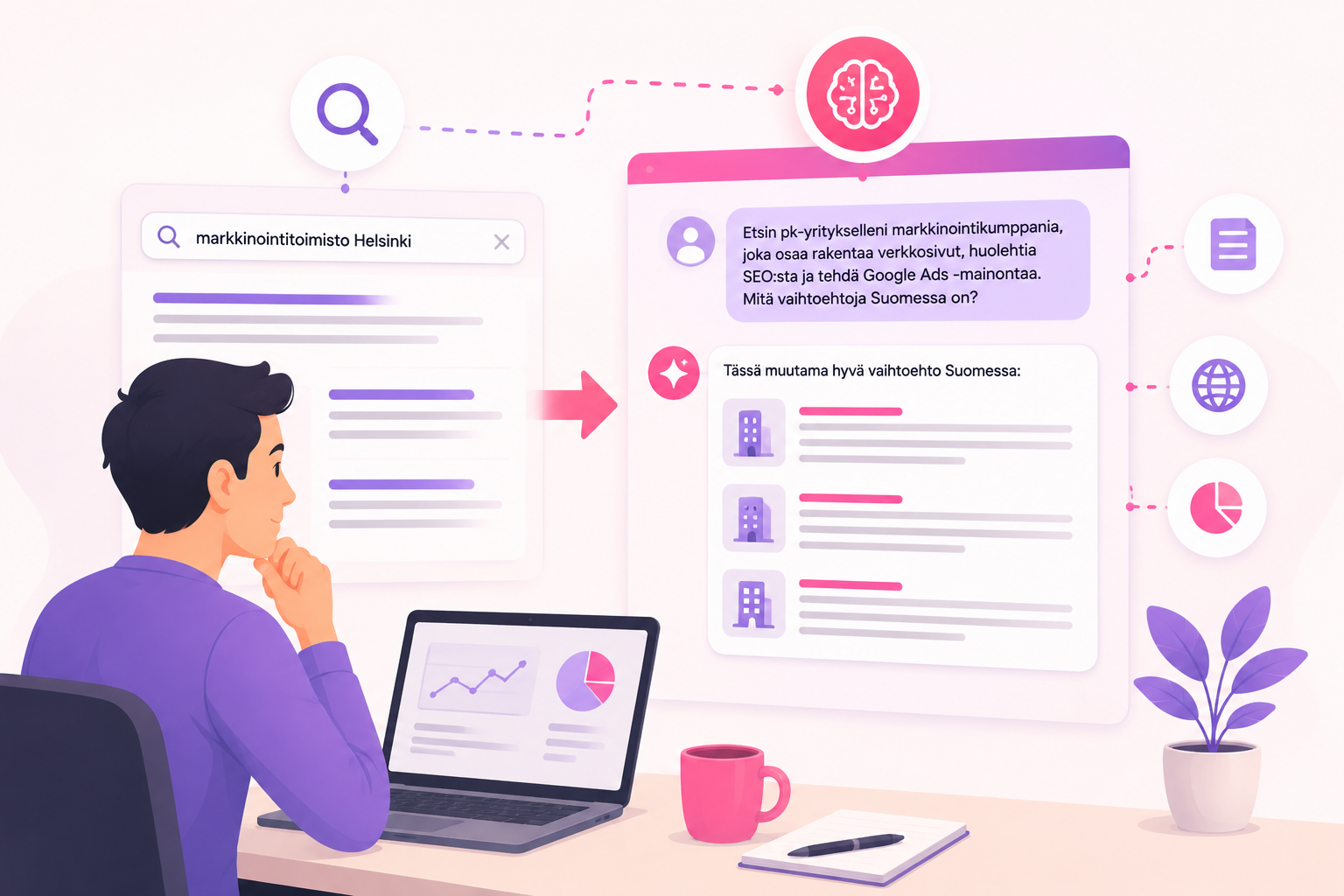
AI search refers to the way people find information using AI-powered services like ChatGPT, rather than typing individual keywords into a traditional search engine.
A traditional Google search might be, for example:
"industrial maintenance company"
In AI search, the same need can be expressed as a complete question:
"I am looking for a company operating in Finland that can handle predictive maintenance for a production facility. Which options should I compare?"
There is a significant difference between these searches.
The former searches for a list. The latter searches for understanding and a recommendation.
Artificial intelligence can combine information from multiple sources, interpret the user's intent, and formulate an answer based on that. From a company's perspective, this means that visibility is no longer just about where your website appears on the search results page.
It is becoming increasingly important what kind of impression the AI forms of the company.
Why should a company be interested in AI search?
The change is particularly significant when the customer does not yet know exactly which company they are looking for.
If a customer searches by company name, they will likely find the website easily. But if they ask:
"Who could help us renovate our production facilities to be more energy-efficient?"
the situation is different.
In such a search, the customer tasks the AI with identifying suitable options. For a company, this means a new kind of discoverability.
In traditional search, the question is often:
Does our website appear in the search results?
In AI search, the question can be:
Does the AI understand what our company does, who it is suitable for, and why it should be recommended?
This also changes the importance of content strategy.
A company should not produce content just around keywords. It should build enough high-quality information on its website and other channels so that both humans and AI can form the most accurate impression of the company possible.
How can a company be found on ChatGPT?
There is no single optimization button for this. You cannot simply add one meta tag to your website and ensure that ChatGPT recommends your business. AI search is a more complex ecosystem.
A company's visibility is influenced by factors such as the information available about it online, how clearly it describes its services, and how well its content answers user questions.
Therefore, it is worth focusing on a few fundamentals.
1. Clearly state what your business does on your website
This sounds obvious, but on many company websites, the actual service offering remains surprisingly unclear.
If a company offers, for example, web design, SEO, and Google Ads advertising, these should be clearly visible on the website.
Not just in the names of the services, but in their content as well.
For example, explain:
- what the service means
- who it is for
- what problems it solves
- what is included in the service
- what goals can be achieved with it
- how the service relates to the company's other activities.
When information is clearly presented, it is easier for both customers and AI to understand.
2. Make your website a source of information, not just a brochure
The purpose of a company website is not just to announce that the company exists. It should help the customer understand what the company is capable of and how it can solve their problem. This is also one reason why expert content continues to play an important role.
A blog can answer questions that a potential customer might be pondering before reaching out.
For example:
- When is the right time for a facade renovation?
- What are the signs that repairs are needed?
- How long does the renovation take?
- How much does a facade renovation cost?
- Can the renovation be carried out in phases?
- How do different material options compare?
When a company's website provides thorough answers to these questions, the site gradually develops into a comprehensive knowledge base.
Internal linking is also important here. For example, Creative Code's previous article The best AI tools for content creation in 2026 serves as a natural follow-up when the reader wants to understand how AI can be utilized in practical content creation.
3. Write about the things your customers actually ask
In AI searches, questions are often more natural and longer than traditional Google searches.
A customer might not search for:
"facade renovation"
but instead asks:
"How do I know if a housing company's facade needs a renovation?"
Or in an online store:
"What kind of electric bike is best suited for long commutes in the Finnish winter?"
This is something to keep in mind for your content strategy.
Good content doesn't try to guess which keyword Google wants to see. It tries to understand what the customer wants to know.
This has long been the core principle of good content marketing. AI search just makes it even more prominent.
4. Build your company's online expertise
AI doesn't evaluate a company based on just one webpage.
Information about a company can be found on websites, articles, interviews, publications, and other online sources. That is why it is worth making your company's expertise visible in a variety of contexts.
If a company wants to be known as an expert in, for example, websites, it should speak about websites consistently across:
- its own website
- blogs
- social media
- client testimonials
- guides
- expert content.
A single article won't build an expert reputation. Multiple pieces of content that support each other can.
5. Take care of your company's basic information
In AI search, a company's basic information is especially important.
Ensure that the following information is consistent across the web:
- company name
- location
- services
- website
- contact details
- industry
- potential experts
- references.
If different sources provide conflicting information about a company, it becomes harder for AI to form a reliable overall picture. This same principle is also important in traditional search engine optimization.
AI search does not mean the end of SEO
When AI search comes up in conversation, one question almost always arises:
Is SEO dead now?
No, it is not.
Search engine optimization remains a vital part of a company's digital presence. However, a new perspective has emerged alongside traditional SEO.
Previously, a company's goal might have been to rank at the top of Google for a specific keyword. Now, it is also worth considering whether the company's content appears in the questions users ask AI.
These goals support each other.
Good SEO already includes many elements that also help with AI search:
- clear structure
- high-quality content
- expert answers
- natural language
- internal linking
- technically sound website
- clear topical authority.
Therefore, AI search does not necessarily mean building an entirely new marketing channel. For many companies, the first step is to make their existing website a better source of information.
What about AEO and GEO?
When it comes to AI search, two terms often come up: AEO and GEO. AEO, or Answer Engine Optimization , refers to optimizing content for answer engines. The idea is to create content that provides the best possible answer to a user's question.
GEO, or Generative Engine Optimization , refers to optimizing content for generative AI systems. These terms are relatively new, and there is no need to build an entirely separate marketing machine around them. In practice, a good starting point is much simpler:
Make your website as useful, clear, and reliable a source of information as possible.
When content serves people well, it simultaneously creates better conditions for visibility in new search methods as well.
Your brand matters more in AI search than you might think
AI search also highlights one thing that is easily overshadowed by technical SEO discussions: the importance of your brand.
When a user asks AI for recommendations, they don't necessarily want a list of every possible company. They want options that fit their specific situation. That is when a company needs to be understood. What does the company do? Who is it for? In what situations should it be considered? What sets it apart from others? Answering these questions is largely a matter of branding.
A brand is not just a logo or a visual identity. It is the overall impression people form of a company. The same applies to how a company is understood through AI. You can read more about corporate branding on our blog: Corporate branding – why a strong brand is much more than a logo?
The customer may no longer find the company – but rather the solution to their problem
This is perhaps the most significant change. In traditional search, a customer might look for a specific service. With AI search, they can start with their problem.
For example:
"Our company's production costs have risen and we want to find out where the most waste is generated in our process. Where should we start?"
In this case, AI can offer several potential solutions.
A company that has produced online content specifically about this problem is in a better position than a company whose website only lists its services.
The same can happen on the consumer side.
A customer might not ask:
"Buy a dishwasher."
They ask:
"Which dishwasher is suitable for a small kitchen with limited space and two children?"
In such a situation, understanding the customer's problem becomes more important than mentioning a single product.
This makes a customer-centric content strategy even more important. Content shouldn't just talk about what the company sells. It should also talk about what the customer is trying to solve.
How to prepare for AI search in practice?
If you want to improve your company's visibility in AI search, start with these:
1. Review your website's most important service pages
Can an outsider quickly understand what the company does and for whom?
2. List your customers' most common questions
What do customers ask before making a purchase?
Turn these questions into content topics.
3. Audit your existing blog posts
Do they answer real questions, or is the content written primarily for search engines?
4. Build connections between your content
Link related articles to one another. This turns individual blog posts into a cohesive whole.
5. Showcase your company's expertise
Share experiences, insights, projects, and the problems you solve for your customers.
6. Ensure a solid technical foundation
Great content won't help if your website is slow, difficult to use, or technically flawed.
7. Don't try to optimize everything for AI
At the end of the day, content is still written for people.
If an article answers a customer's question well, it is usually a great starting point for new types of searches as well.
AI search makes content even more important
Artificial intelligence does not diminish the importance of good content. It may even make it more critical. As information retrieval becomes more conversational, companies must be able to answer customer questions clearly and comprehensively. In practice, this means doing more than just writing blog posts.
Your website, service pages, case studies, blogs, social media, and other content should form a cohesive whole that tells the same story about your company from different perspectives. When this happens, content is no longer just an isolated marketing tactic. It simultaneously builds search engine visibility, establishes your reputation as an expert, and fosters trust.
This is also why a website redesign should never be viewed as just a visual update. Your site should help both people and search engines understand what your company does and why it matters.
Summary
AI search is changing how people find and compare companies.
Companies should no longer think of visibility solely in terms of appearing on the first page of Google. It is becoming increasingly important to provide enough high-quality, consistent information so that AI can understand your expertise, services, and suitability for various needs.
The good news is that this doesn't mean you need to build an entirely new marketing strategy.
A clear website, useful content, solid SEO, a strong brand, and an expert content strategy remain the foundation of effective visibility.
AI search simply changes the situations in which customers encounter this information and how they interact with it.
Frequently Asked Questions
How can a company appear in ChatGPT’s responses?
There is no single guaranteed way to do this. A company should ensure that there is enough up-to-date, clear, and high-quality information about it online. A good website, expert content, consistent business information, and a strong digital presence form an important foundation.
Is AI search the same thing as SEO?
Not exactly. SEO focuses on search engine visibility, while AI search relates to the responses generated by AI services. However, the methods support each other in many ways, as high-quality, well-structured content is important for both.
What is AEO?
AEO, or Answer Engine Optimization, refers to optimizing content for answer engines. In practice, the goal is to answer users' questions clearly and helpfully.
Should a company create content specifically for ChatGPT?
Content should primarily be created for customers. When content answers their questions thoroughly, clearly, and expertly, it simultaneously serves search engines and new AI-based search methods.
Will AI search replace Google?
It is not reasonable to assume that one will completely replace the other. People use different ways to search for information depending on the situation. It is more sensible for a company to ensure that its digital presence works across multiple environments.
In conclusion
AI search is just one part of the shift in marketing. For companies, the most important question is ultimately not how to get visible in a single AI service.
A more important question is:
Is there enough accurate information about your company online so that a customer—or the AI assisting them—understands why your company might be the right solution?
If the answer is yes, you are already building visibility for the search methods of the future.
If you would like to discuss how AI search, SEO, content, and websites could work better together for your specific business, we would be happy to talk. Ask more here.