


Blogi

Introduction
A company invests in Google Ads, publishes content on social media, or sends out an email campaign. The ads generate clicks and drive traffic to the website, but there are fewer inquiries or quote requests than expected.
In many cases, the problem isn't the volume of traffic, but where the visitor is being directed.
A good landing page is more than just an attractive webpage. Its purpose is to help the visitor take the next step as easily as possible. When a page answers the exact question that brought the visitor there, the conversion rate is much more likely to increase. Research and practical optimization work show that a clear message, a single primary goal, and minimal friction improve landing page performance.
In this article, we will go through what makes a good landing page, why it has such a significant impact on marketing results, and how it should be considered as part of a company's overall marketing strategy.
What is a landing page?
A landing page is a standalone page on your website designed to guide the visitor toward one specific, predefined action. This is usually the first page a person lands on after clicking from Google or social media.
It could be, for example:
- filling out a contact form
- submitting a request for a quote
- downloading a guide
- booking an appointment
- purchasing a product
- registering for a webinar
Unlike a company homepage, a landing page doesn't try to tell the whole story of a business. It focuses on one service, one target audience, and one goal.
It is precisely this focus that makes it effective.
Why is a landing page important?
Many companies direct all their traffic to their homepage.
That sounds logical, but in practice, a homepage tries to serve many different types of visitors at the same time:
- new customers
- existing customers
- job seekers
- partners
- the media
A landing page works differently.
It continues the conversation that the visitor started in an ad, search result, or email. When the message remains consistent throughout the journey, the visitor doesn't have to waste energy wondering if they are in the right place. This is often called message match, and it is one of the most important factors in a successful landing page.
Key features of a good landing page
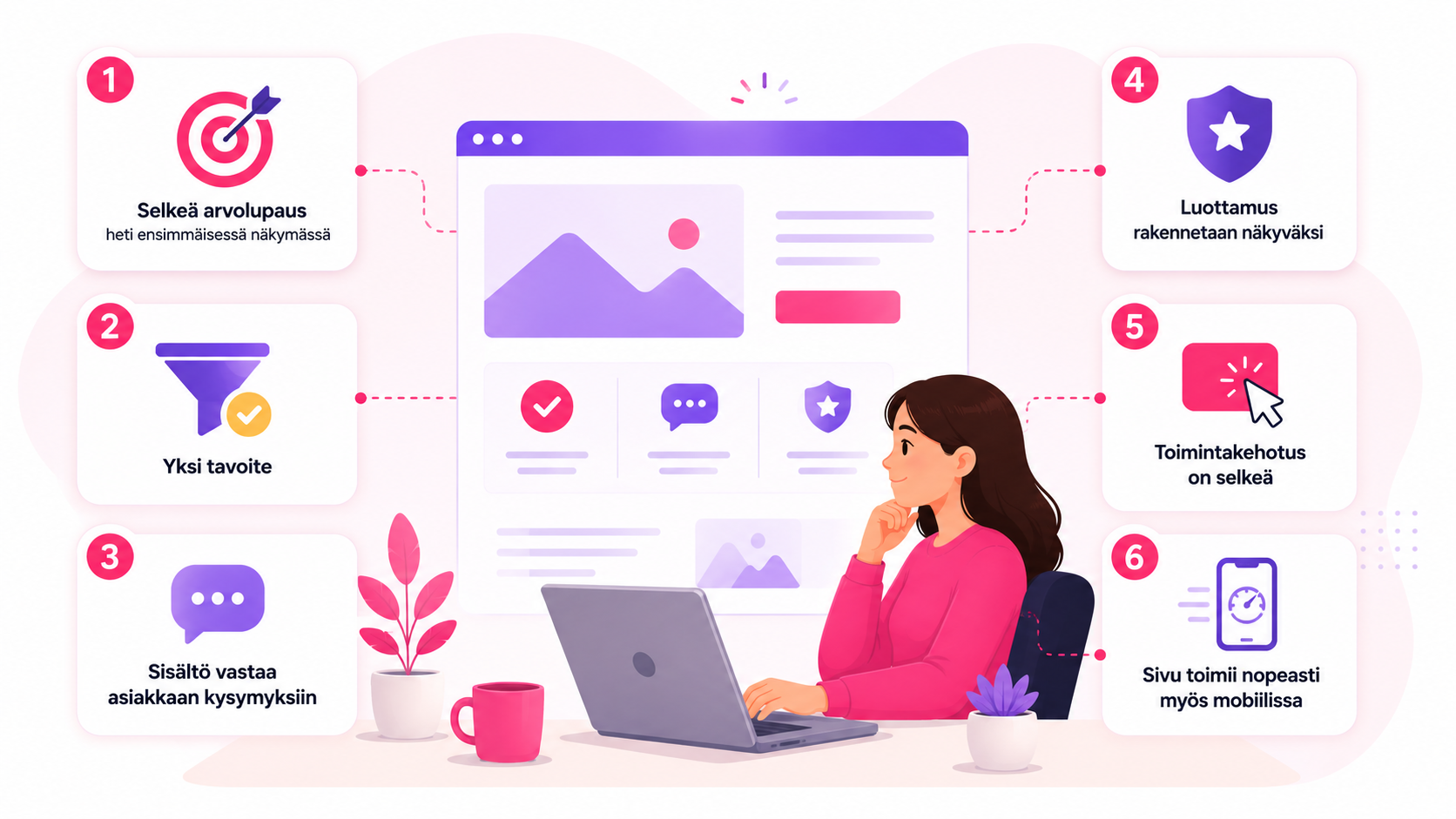
1. A clear value proposition in the hero section
Within the first few seconds, a visitor evaluates three things:
- What is being offered here?
- Is this for me?
- Why should I continue?
If these questions aren't answered quickly, the visitor will leave. A good headline doesn't try to be clever. It simply states the benefit the customer will receive.
2. A single goal
One of the most common mistakes is trying to get the visitor to do too many things.
On the same page, you might be asked to subscribe to a newsletter, book an appointment, read a blog, follow on social media, and explore all services.
The more options you provide, the harder it is for the visitor to make a decision. A good landing page guides the user toward a single goal.
3. Content answers the customer's questions
A good landing page doesn't focus on talking about the company. It focuses on the customer's situation.
For example, the visitor wants to know:
- does this solve my problem
- how does the service work
- what happens next
- how much effort is required from me
- can I trust this company
When content is built around these questions, the page helps the visitor move naturally toward a decision.
4. Trust is made visible
Most people don't reach out based on a first impression alone.
They look for signs that the company is credible.
Trust can be built through, for example:
- customer testimonials
- reviews
- completed projects
- certifications
- notable clients
- clear company overview
Trust is not built on a single element, but on the whole.
5. The call to action (CTA) is clear
If the goal of the page is to generate leads, it should be visible throughout the entire page.
A good CTA tells the user exactly what happens next.
For example:
- Request a quote
- Book a free consultation
- Contact us
In contrast, generic buttons like "Read more" do not always tell the visitor what the next step entails.
6. The page performs well on mobile
The majority of business web traffic now comes from mobile devices.
If a page loads slowly or filling out a form is difficult on a phone, some visitors will leave before they even have a chance to read the content.
Technical performance is an integral part of the user experience, not a separate development task.
A landing page cannot work alone
One of the most common misconceptions is thinking that a good landing page can fix poor marketing. In reality, a landing page is just one part of the whole. For example, a Google Ads campaign can bring the right target audience to the page, but if the page does not deliver on the promise of the ad, clicks will not turn into leads. Similarly, search engine optimization can increase organic traffic, but without a clear landing page, much of that potential remains untapped.
That is why landing pages should be viewed as part of an entire marketing ecosystem, where advertising, search engine visibility, content, and website user experience all support one another.
If you're interested in this topic, you can also dive into our previous articles:
- Google Ads – a guide for businesses that want more than just clicks
- Why aren't your company's website generating leads?
- Business websites – a guide to a site that grows your business
These topics complement the importance of landing pages as part of an effective marketing strategy.
Common landing page mistakes
Too much content
You don't need to say everything on a single page.
Often, the most important thing is to answer the specific questions that help the visitor move to the next stage.
Too many calls to action
When every button leads to a different place, the visitor often decides to do nothing at all.
Unclear headline
If a visitor doesn't immediately understand what the company offers, they will leave quickly.
Mismatch between ad and page
If an ad promises one thing but the page talks about something else, trust is immediately undermined. A consistent message from the ad to the landing page is one of the key factors affecting conversion.
Continuously improve your landing page
A great landing page is rarely created on the first try.
That is why you should monitor the page's performance by tracking, for example:
- where visitors come from
- how far they scroll
- at what point do they leave
- how many people fill out the form
- how different traffic sources perform
Even small changes—such as clarifying a headline, a form, or a call to action—can have a significant impact on how many visitors become customers. The best solution is often found through testing, not guessing.
Summary
A good landing page isn't the most visually impressive website. It is a page that helps the visitor make a decision. When the message is clear, the content meets the customer's needs, and the next step is easy to take, marketing works more effectively.
At the same time, it is worth remembering that a landing page should not be developed as an isolated project. It works best when it supports the company's other marketing efforts—search engine visibility, advertising, content, and the website as a whole. That way, every investment in marketing moves in the same direction.
Frequently asked questions
What is the most important goal of a landing page?
To guide the visitor to take one clear action, such as getting in touch, requesting a quote, or making a purchase.
Is a separate landing page needed for every campaign?
Often, yes. When the page corresponds precisely to the campaign's message and target audience, it is easier for the visitor to find the information they are looking for and move toward the goal.
Can a homepage serve as a landing page?
In some situations, yes, but most of the time a dedicated landing page works better. A homepage usually has multiple goals, whereas a landing page focuses on one.
How do I know if a landing page is working?
Visitor numbers alone are not enough of a metric. You should track things like the number of inquiries, form completion rates, conversion rates, and how users progress through the page.
Interested?
If you are wondering how your company's landing pages could better support your marketing and increase inquiries, we would be happy to discuss it. Often, even small changes can make the customer journey clearer and your overall marketing more effective.
Read more about our website services here: Websites and digital presence