



Blogi

Introduction
Social media is in a constant state of flux. New channels emerge, algorithms shift, and the ways users consume content evolve year after year. At the same time, businesses often feel pressured to be present everywhere.
In reality, few companies benefit from trying to do everything at once.
In 2026, social media success won't be based on how many channels a company is on, but on how well the chosen channels support business goals. When social media is viewed as part of a company's overall marketing strategy, it becomes a powerful tool for building awareness, trust, and customer relationships—rather than just a place to post random updates.
In this article, we’ll walk through how a company can choose the right social media channels in 2026 and why making a strategic choice is more important than ever.
Why being everywhere no longer pays off
Just a few years ago, businesses were often advised to set up profiles on every major platform. The logic was understandable: the more visibility, the better.
In practice, the results were often quite different.
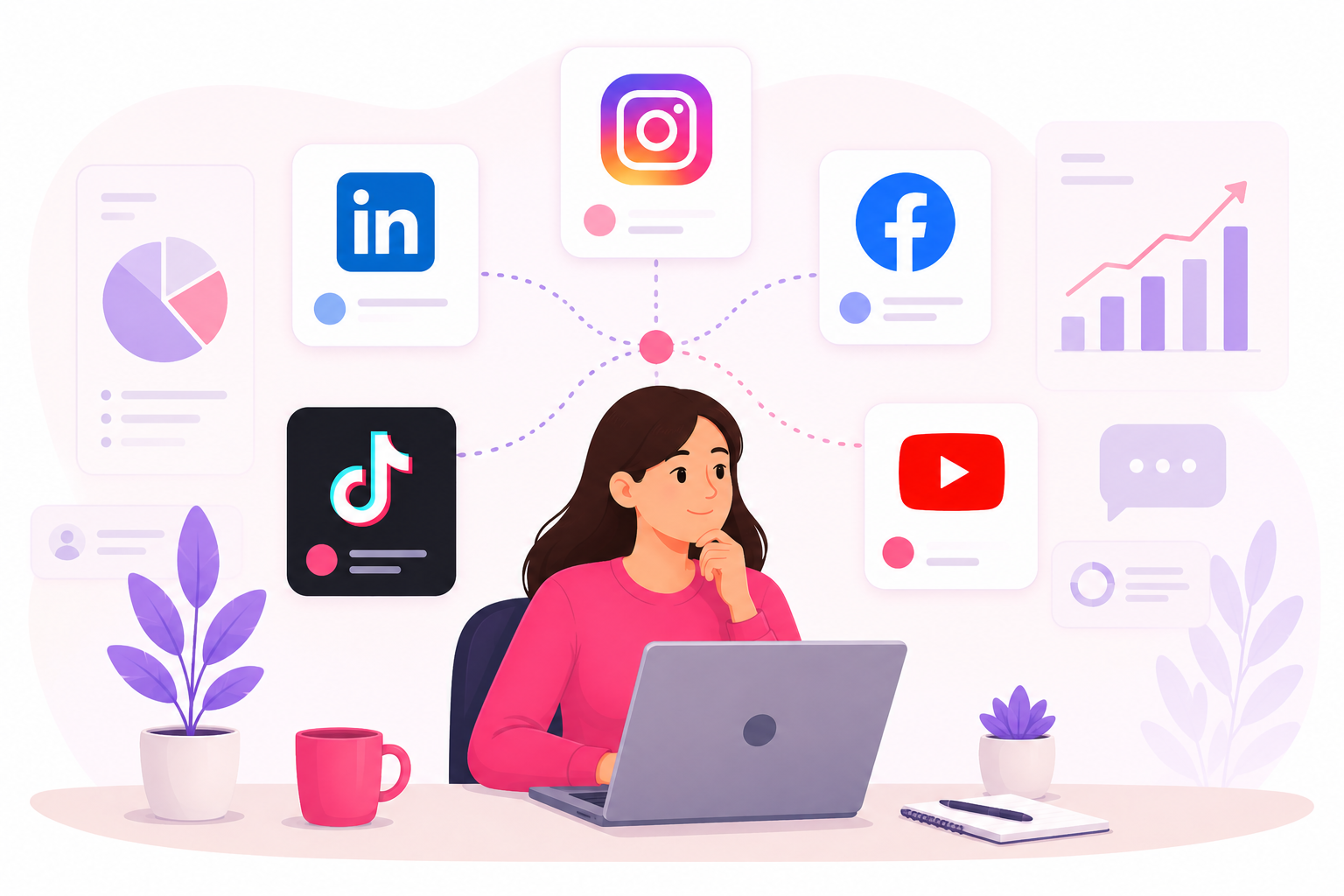
A company posts the same content to Facebook, Instagram, LinkedIn, TikTok, and YouTube. The posting frequency drops, the content becomes repetitive, and eventually, none of the channels effectively support the business.
Today, algorithms reward activity, high-quality content, and audience engagement. This is significantly easier to achieve in a few carefully selected channels than in five that are maintained at half-capacity.
That is why the first question is not:
"Where should we be?"
But rather:
"Where do our customers make decisions and look for information?"
Social media channels for businesses in 2026
LinkedIn – the channel for expertise and B2B business
LinkedIn has solidified its position as the most important social media platform for business decision-makers, experts, and B2B companies.
In 2026, the companies that will succeed on LinkedIn are those that:
- share expert knowledge
- share solutions to customer problems
- provide business insights
- build long-term trust.
Corporate news alone is no longer enough. People follow people, not logos.
Instagram – a visual brand builder
Instagram remains an effective channel, especially when a company's services or expertise can be easily communicated through images, videos, and stories.
Great content includes, for example:
- customer case studies
- behind-the-scenes moments
- everyday work life
- tips
- short tutorial videos.
A company doesn't need to be "entertaining." It needs to be interesting to the right target audience.
Facebook – still relevant for many businesses
Although Facebook is no longer the primary platform for the youngest users, it still holds a strong position, particularly for local businesses, communities, and many consumer markets.
Facebook works well for, for example:
- event marketing
- local visibility
- building customer communities
- paid advertising.
The value of a channel depends primarily on your target audience, not on how much it is talked about in marketing circles.
TikTok – visibility through authentic content
TikTok is no longer just an app for young people.
Companies are increasingly using it for expert content, recruitment, behind-the-scenes videos, and showcasing products and services.
On TikTok, perfect production isn't what matters most.
Instead, what works is:
- authenticity
- speed
- an engaging perspective
- storytelling.
However, TikTok isn't the right choice for every business.
If your customers make purchasing decisions through a long bidding process, for example, LinkedIn or search engine visibility may provide more value.
YouTube – a long-term content investment
YouTube differs from other social media channels in that its content can generate visibility for years to come.
Good content includes, for example:
- guides
- frequently asked questions
- expert interviews
- webinars
- customer stories.
In addition, YouTube effectively functions as a second search engine.
When a customer searches for a solution to their problem in video format, well-optimized content can still be found long after it was published.
How do you choose the right channels?
It is best to approach channel selection from a business perspective.
A good starting point is to consider the following questions:
Where do your customers spend their time?
Not all customers behave the same way. For some, LinkedIn is the most important meeting place. For others, it’s Instagram. For a third group, it’s Google. That is why copying your competitors is usually not a good strategy.
Instead, you should examine the customer's entire buying journey. Where do they first encounter your company? Where do they look for more information? Where do they compare options or ask for recommendations? Different channels can serve different stages of the decision-making process.
For example, a potential B2B customer might come across an expert article on LinkedIn, but then move to the company's website to read more detailed information about services. On the consumer side, a customer might discover a company on Instagram, but search for reviews on Google or check out the company's website before making a purchase decision.
It is also worth remembering that social media usage is not divided solely by age. Although different generations have their own favorite channels, it is often more decisive what kind of information the customer is looking for and in what situation. The same person might use LinkedIn during the workday, YouTube to solve a problem, and Instagram for inspiration in their free time.
Therefore, channel selection should not be based on assumptions, but on your own data whenever possible. Website analytics, social media statistics, customer surveys, and insights from the sales team can together reveal where customers actually come from and what kind of content sparks their interest.
When a company understands its customers' digital behavior, social media choices become significantly clearer. The goal is not to be where there are the most users, but where your specific customers are ready to get to know your company and take the next step. This also makes content production more consistent and helps focus limited resources where they have the greatest impact on the business.
What kind of content is your company capable of producing?
Don't choose your channels based solely on popularity. It is just as important to consider what kind of content your company can realistically produce with high quality and consistency over the long term.
If your company has deep expertise, blogs, LinkedIn, and YouTube can form a powerful combination. If your daily operations are visual and easy to capture, Instagram and TikTok may be more natural choices.
Many companies think they need unique content for every channel. In practice, however, one piece of high-quality content can be repurposed in many ways. For example, an expert blog post can be turned into a LinkedIn update, a short social media video, or an in-depth YouTube video.
The most important thing is to choose channels that your company has the time and expertise to maintain. Long-term, consistent content production builds trust far more effectively than activity that fizzles out after a few months.
What is the goal?
Social media can serve many different purposes.
For example:
- increasing brand awareness
- building an expert reputation
- lead generation
- recruitment
- maintaining customer relationships.
A single channel can support multiple goals, but you shouldn't try to achieve every objective with the same content.
Social media doesn't work alone
One of the most common misconceptions is thinking that social media alone is enough for marketing.
In reality, it works best when it guides people forward.
For example, an engaging LinkedIn post can lead a reader to explore the topic further on your company blog. The blog, in turn, can help them better understand your services, and well-designed website pages make getting in touch as easy as possible.
The same logic works in reverse. A blog post found via search engines can be shared on social media to reach a new audience, allowing one piece of high-quality content to serve multiple channels.
For this reason, you shouldn't plan social media as an isolated part of your marketing. When your channels, website, content marketing, and search engine visibility support each other, the whole generates more value than individual efforts alone.
If you want to dive deeper into how your website affects marketing results, be sure to also read our blog "Why isn't your company website generating leads? – How to improve your site's sales". Similarly, "Google Ads – a guide for companies that want more than just clicks" explains how paid advertising works most effectively as part of a broader marketing strategy. In addition, "Corporate branding" covers how a consistent brand is reflected in every customer interaction – including on social media.
Quality beats quantity in 2026
Companies no longer gain a competitive advantage by simply posting the most content.
Competitive advantage comes from content that provides value.
When a company understands its customers' questions, answers them consistently, and does so in the right channels, social media begins to support the entire business.
Then, every post is not an isolated update, but part of a long-term marketing strategy.
Summary
Choosing social media channels is not a competition to see who can be visible on the most platforms.
It is about where a company can meet its customers, build trust, and support its business goals.
In 2026, the best results will go to companies that dare to focus. A few well-managed channels, high-quality content, and a clear connection to your website, search engine visibility, and other marketing efforts create a significantly stronger foundation than a broad but fragmented presence.
Frequently asked questions
What are the most important social media channels for businesses in 2026?
It depends on your target audience and goals. LinkedIn is particularly well-suited for B2B companies and expert communication, Instagram for visual brand building, Facebook for local visibility and communities, TikTok for authentic video content, and YouTube for long-form expert content.
Should a company be on every social media channel?
Usually, no. Focusing on a few carefully selected channels generally yields better results than spreading your resources too thin.
How does social media support search engine visibility?
While social media does not directly affect search engine rankings, it increases the visibility of high-quality content, drives traffic to your website, and can boost brand awareness. Combined with SEO-optimized blogs and a functional website, it strengthens your entire digital marketing strategy.
How often should a company post content?
Consistency is more important than a high volume of posts. Your posting schedule should be one that your company can maintain long-term without compromising the quality of the content.
If this sparked some thoughts
Social media works best when it supports your other marketing efforts rather than standing alone. If you would like to discuss which channels would best support your company's goals or how they can form a cohesive strategy alongside your website, content production, and search engine visibility, we would be happy to talk.
Read more about our service: Social media